09.2026
ArcadeVerse
Community-driven Google Cloud Arcade analytics, milestone tracker, and swag tier readiness engine.
 React
 TypeScript
 Tailwind CSS
 Node.js
 Express
 MongoDB
 Vercel
Introduction
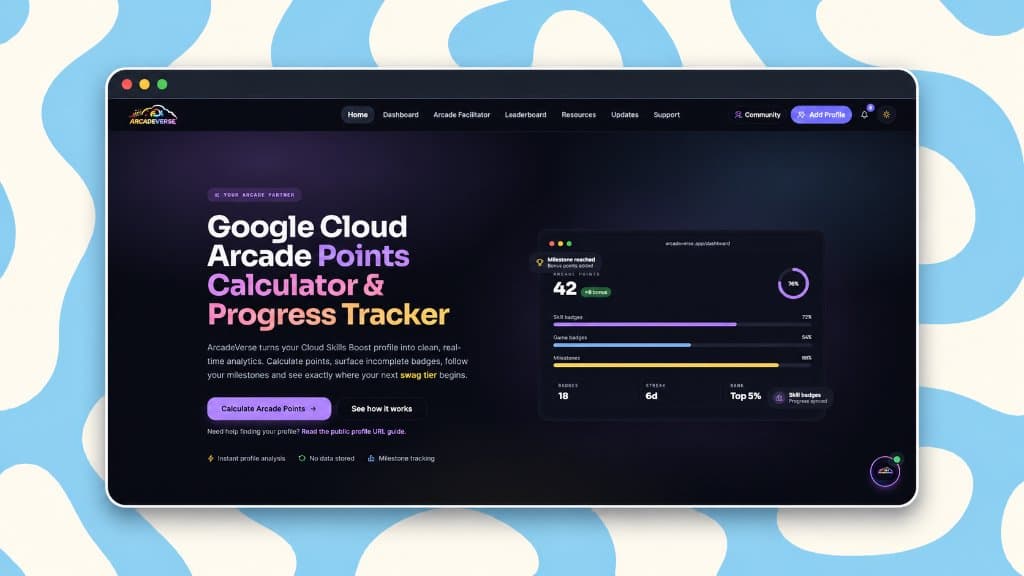
ArcadeVerse is an independent, community-driven cloud analytics and gamification platform built for developers, students, and cloud professionals participating in the Google Cloud Arcade Program.
It provides real-time milestone tracking, public profile badge auditing, automated point ledger calculation, and readiness algorithms that project how many skill badges or game arcade points a user needs to reach their target swag tiers.
Verified impact & reach
- 5,500+ unique website visitors tracked across active program cohorts.
- 5,000+ public cloud profiles analyzed and audited.
- Active community adoption among cloud learners seeking real-time milestone projection and progress verification.
Why I built it
The Google Cloud Arcade Program rewards hands-on cloud labs across Compute Engine, BigQuery, Kubernetes, and Cloud Run. However, participants face recurring friction points:
- Fragmented progress tracking: Badge completions, game completions, and trivia challenges are scattered across disparate learning pages.
- Complex point ledger rules: Calculating cumulative points, bonus point multipliers, and eligible milestone badges manually is tedious and error-prone.
- Deadline uncertainty: Participants often do not know whether they are on track to achieve Standard, Advanced, or Premium swag tiers before cohort closing dates.
I built ArcadeVerse to provide a single, verified analytics dashboard where users can paste their public profile URL and immediately understand their standing, point totals, and remaining requirements.
Core features
- Automated public profile audit: Parse and verify publicly shared Google Cloud Skills Boost profile pages without requiring user credentials.
- Milestone & swag tier readiness engine: Algorithmic projection calculators that compare current point ledgers against cohort swag tier thresholds.
- Point ledger breakdown: Granular itemization of Arcade Game Points, Skill Badge Points, Trivia Points, and Special Milestone Bonuses.
- Responsive dark-mode UI: Lightweight, high-performance interface with interactive tier progress rings and instant client-side filtering.
- Privacy-first architecture: Operates exclusively on publicly published profile links; zero passwords, private tokens, or sensitive account data are ever stored.
- Edge-cached delivery: Built on React and deployed on Vercel with edge caching for instant global page loads.
How it works
- Profile submission: A learner submits their public Google Cloud Skills Boost profile link.
- Metadata extraction: The backend fetches the public HTML document, validates the profile identifier, and extracts earned badge titles, completion dates, and quest categories.
- Deduplication & verification: Duplicate attempts, legacy expired badges, and non-eligible credentials are automatically filtered out.
- Point aggregation: The scoring engine applies authoritative cohort rules to compute totals across arcade games, skill badges, and milestone thresholds.
- Readiness projection: The system calculates the shortest path of remaining labs required to reach the next swag tier.
- Dashboard rendering: The frontend presents an interactive visual breakdown with completion checklists and progress meters.
System architecture
ArcadeVerse is built with a separated client-server architecture:
- Presentation layer: Modern React application with TypeScript and Tailwind CSS, featuring accessible data tables and animated progress visualizers.
- Backend services: Node.js and Express microservice responsible for profile parsing, rate limiting, and cache invalidation.
- Persistent cache: MongoDB document database used to cache verified profile metadata, minimizing redundant external HTTP requests and maintaining fast response times.
- Open-source showcase repository: The presentation layer is published openly in the
arcadeverse-devrepository, while proprietary scraping and calculation engines remain safely isolated in the private repository.
Tech stack
- React & TypeScript: Client application state, component architecture, and type safety.
- Tailwind CSS: Responsive utility styling and dark-mode color palette.
- Node.js & Express: Backend REST service and rate-limited aggregation endpoints.
- MongoDB: Caching layer for audited profile snapshots.
- Vercel: Production continuous deployment, edge CDN routing, and asset optimization.
Engineering challenges
Handling high cohort-deadline traffic
During the final days of Google Cloud Arcade cohorts, visitor traffic spikes dramatically as thousands of participants verify their point totals simultaneously. Implementing caching layers with MongoDB and exponential backoff ensured continuous uptime without external rate limiting.
Parsing dynamic public profile layouts
The structure of Google Cloud Skills Boost profile pages occasionally changes. Designing resilient HTML parsing routines that rely on semantic CSS classes and text tokens rather than brittle DOM indices was essential to maintaining parsing reliability.
Defensive data privacy
ArcadeVerse strictly avoids collecting user emails, passwords, or cloud credentials. All calculations occur solely on public URLs that users deliberately submit for auditing.
Current implementation status
- Live platform: Actively hosted at
arcadeverse.vercel.appand serving community participants. - Open-source showcase: Public repository
AnniiGCP/arcadeverse-devcontains the complete frontend component library and presentation code. - Verified metrics: Over 5,500 unique visitors and 5,000 profiles analyzed to date.
Future improvements
- Cohort trend analytics: Anonymized aggregate statistics showing community-wide completion rates across popular lab quests.
- Personalized lab recommendations: Direct links to recommended labs that yield the highest point return for remaining tier gaps.
- Exportable milestone cards: Shareable achievement badges formatted for LinkedIn and Twitter.
What I learned
Developing ArcadeVerse demonstrated the power of community-focused engineering. Building a tool that genuinely solves an everyday friction point for thousands of users taught me invaluable lessons in traffic management, defensive design, and real-world web performance.